
A Healthier Coat: Rethinking What We Paint Our Homes With
When we choose paint, it’s usually a quick decision.
A colour we like, a finish that sounds practical, a brand we recognise - and we move on.
But every so often it’s worth pausing and asking a different kind of question.
What if the surfaces we live with every day were painted with materials that once grew, rather than materials made from fossil fuels? What if paint behaved more like a finish that ages and breathes, instead of a sealed plastic skin?
This isn’t about nostalgia or going backwards. It’s simply a way of opening a conversation about what paint is actually made from, how it behaves over time, and what it means for our health, our homes and the planet.
Through my work, I’ve come to see paint not as a simple decorative layer, but as a material we live with - on every wall, in every room, for years at a time. Understanding it a little better helps us make choices that are more intentional, and more aligned with the kind of spaces we want to create.
This article isn’t about finding the perfect paint - because that doesn’t really exist. It’s about understanding what’s in the tin, what labels and certifications do (and don’t) tell us, what the environmental impacts are and how to choose a paint that feels right for you.
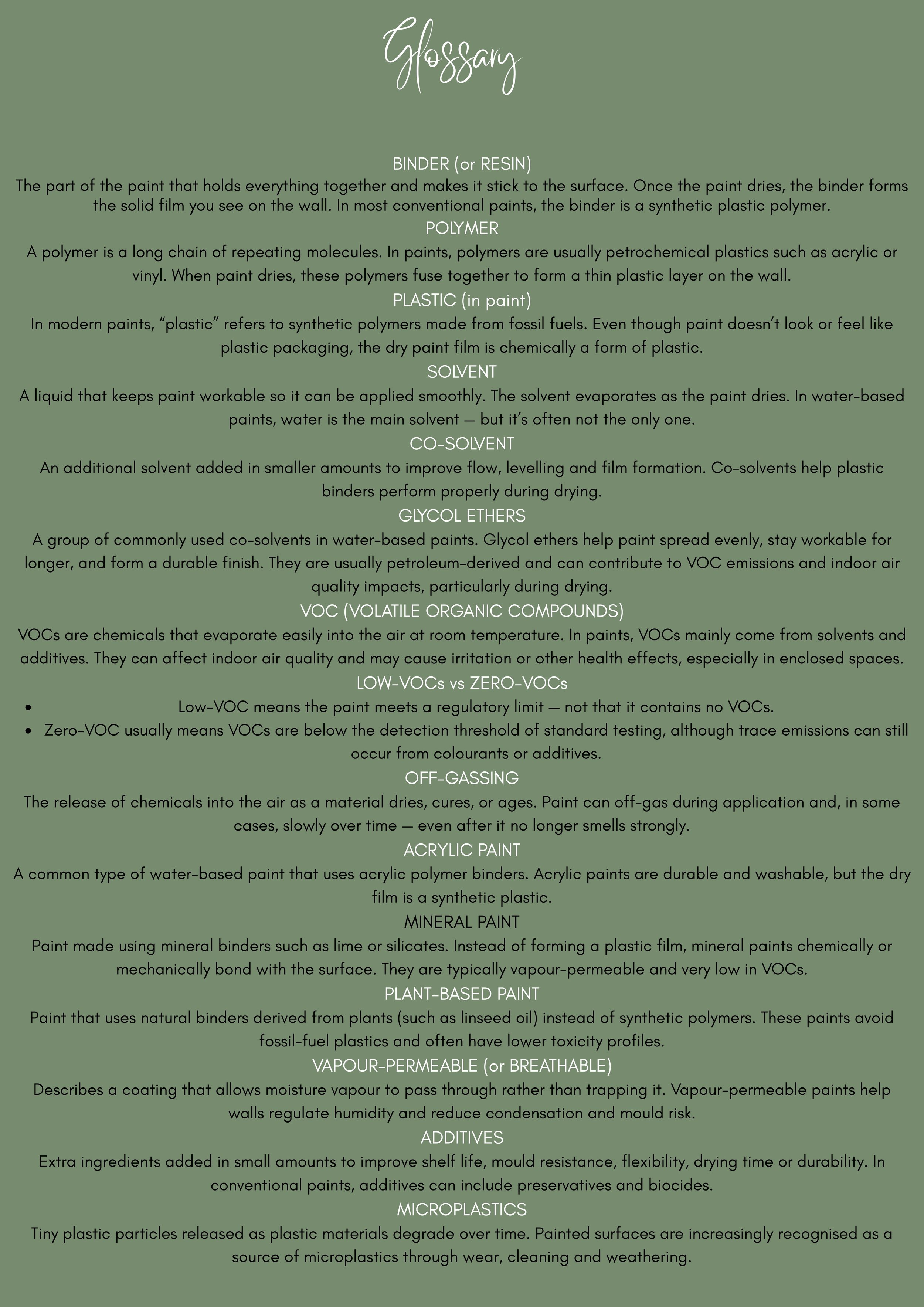
Paint, Materials & Health Terms Explained
What most household paint is actually made from
One of the things that surprises many people is that most modern household paints - including many water-based options - rely on synthetic binders made from fossil fuels.
In simple terms, once the paint dries, what’s left on the wall is usually a thin plastic layer.
This matters because:
– painted surfaces are effectively sealed in plastic
– painted materials are harder to recycle or break down at end of life
– plastic coatings contribute to microplastic pollution as they age and are cleaned
– and the raw materials are tied to fossil fuel extraction and chemical processing
That doesn’t mean all paint is “bad”, and it doesn’t undo the real improvements that have been made over the last couple of decades. But it does help explain why paint has environmental and health implications that often go unnoticed.
Paint is made up of:
· a binder (what holds it together and sticks it to the wall)
· a solvent (what keeps it liquid until application)
· pigments
· and a range of additives for durability, mould resistance and shelf life
When the solvent evaporates, the binder remains. In most conventional paints, that binder is plastic.
Once you know this, it becomes easier to understand why some people start looking for alternatives - and why others decide that a well-certified, lower-impact conventional paint is still the right choice for them.
Neither approach is wrong. They’re simply different.
Water-based doesn’t mean solvent-free
“Water-based” is often assumed to mean gentle or chemical-free. In reality, it means that water is the primary solvent - not the only one.
Most water-based acrylic paints still contain:
· small amounts of co-solvents (often glycol ethers)
· preservatives and biocides
· performance additives
These are there because plastic binders can’t form a durable film with water alone.
Water-based paints are generally an improvement on older solvent-heavy systems, particularly for indoor air quality - but they’re still chemically engineered products.
Low-VOC doesn’t automatically mean low-hazard
Reducing VOCs has been one of the biggest regulatory wins in the paint industry, and it matters. Lower VOCs usually mean less smell, less irritation, and fewer short-term exposure issues.
But this is where things get nuanced.
Low-VOC does not automatically mean low-hazard.
VOC numbers tell us about one group of chemicals - not the whole formulation.
They don’t fully capture:
· non-volatile toxic ingredients
· endocrine-disrupting substances
· persistent or bio accumulative chemicals
· or the broader lifecycle impacts of plastic polymers or microplastics
So, a paint can meet strict low-VOC limits - and even carry strong health ratings - while still containing ingredients some people prefer to avoid.
I tend to think of low-VOC as a bare minimum, not a finish line.
Regulation has improved - but concerns remain
There’s no doubt regulation has tightened. VOC limits are lower, labelling is clearer, and some historically hazardous substances (think lead paint) are now restricted or banned.
At the same time, research continues to raise concerns about the presence and cumulative impact of toxic substances in household paints, including formaldehyde, fungicides, heavy metals and VOCs - even in products that meet current standards (Coulthard, 2020).
Because paint:
· covers large interior surface areas
· stays in our homes for years
· and contributes to long-term, low-level exposure
these questions still matter - particularly for children, people with asthma, or anyone with chemical sensitivities.
The environmental impact we don’t see
Most of the time, we only think about paint once it’s on the wall. But there’s also the question of how it’s made.
Conventional paint manufacturing is chemically complex and resource-intensive. Research suggests it can generate around ten litres of waste for every litre of paint produced, sometimes more for specialist coatings (Coulthard, 2020).
This upstream impact isn’t always visible — and it isn’t always captured by product labels or certifications that focus on in-use performance.
So, what about plant-based and mineral paints?
Plant-based and mineral paints offer a genuinely different approach - but they aren’t a silver bullet.
Plant-based paints: imagining something different
In a recent post, I invited people to imagine what it might mean if our homes were painted with plant-based materials instead of plastic.
Not as a perfect solution or a moral position - just as a thought experiment.
What if the surfaces we live with every day were made from materials that once grew, rather than materials pulled from the ground and chemically transformed? What if paint behaved more like a natural finish than a sealed skin?
That question is often what draws people toward plant-based paints.
Plant-based paints typically use plant oils or bio-derived binders, sometimes combined with mineral fillers and pigments. In theory, this can reduce reliance on fossil fuels and shift paint closer to a renewable material cycle.
But this is also where nuance matters.
“Plant-based” isn’t a regulated term, and there’s wide variation between products. Some paints described this way still contain:
· petrochemical ingredients, just in reduced quantities
· synthetic additives for performance or shelf life
· or solvents that are natural in origin but still irritating or harmful at certain exposure levels
In other words, plant-based doesn’t automatically mean plastic-free, low-tox, or benign.
That doesn’t make these paints irrelevant - far from it. For many people, they represent a meaningful step toward aligning materials with values around renewability, sufficiency and reduced petrochemical dependence. But, as with conventional paints, the details matter.
I tend to approach plant-based paints the same way I approach everything else: with curiosity, questions, and a willingness to look beyond the headline.
Mineral paints (lime and silicate)
Mineral paints are among the oldest paint technologies we have. They:
~ don’t form a plastic film
~ allow walls to breathe
~ are naturally mould-resistant
~ are typically very low or zero VOC
In their pure form, mineral paints use little to no plastic at all. That’s appealing to many people - myself included - where the surface and expectations suit.
That said, some modern mineral paints include small amounts of synthetic binders, and accessory products (primers and sealers) can quietly reintroduce plastics and other hazards if you’re not paying attention.
A practical hierarchy - with caveats
As a general guide:
· plant-derived, water-based paints tend to be the most eco-friendly
· followed by plant-based paints using natural solvents
But even natural solvents can be irritating or harmful to human bodies. This is why low VOC content and low VOC emissions still matter, regardless of whether a paint is conventional or natural (Coulthard, 2020).
For me, the most considered choices sit at the intersection of:
· material type
· transparency
· health impacts
· environmental impacts
· and realistic expectations about performance and care
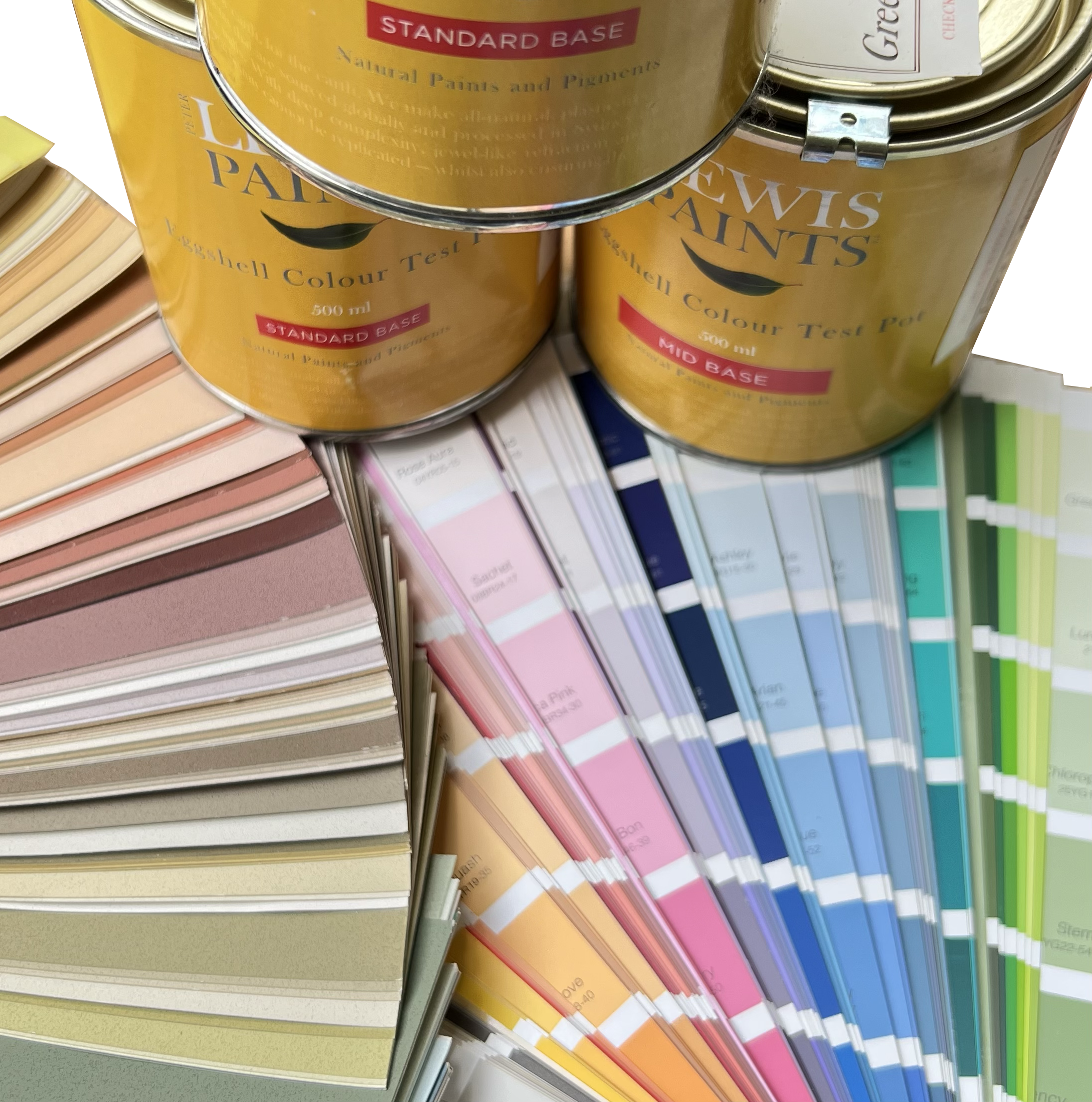
Paints are typically chosen by colour, brand or finish, but we need to look into what is actually in the tin
How certifications fit in
Certifications such as Global GreenTag and GECA are valid and valuable. They provide independent verification, raise baseline standards, and help compare like-for-like products.
At the same time, they have limits:
· they’re generally category-based, not absolute
· they don’t distinguish between plastic-based and mineral paints
· and they don’t yet reflect the full diversity of paint technologies
Ingredient-focused frameworks such as Declare and the Red List add another layer by prioritising transparency and the avoidance of worst-in-class chemicals. Their work is invaluable for getting down to the nitty gritty details. However, paint is one of the most chemically complex materials in our homes, and it currently remains under-represented in ingredient transparency programs. This is partly because paint formulations are often proprietary, and full ingredient disclosure can be commercially sensitive for manufacturers.
No single label tells the whole story.
How I think about choosing paint
When I’m helping clients - or choosing for my own home - I don’t start with brands. I start with questions:
· What matters most here - health, durability, feel, values, or a mix?
· What is needed from the product and will it suit the local conditions?
· Is this a space where breathability matters?
· How sensitive are the occupants?
· What am I comfortable maintaining over time?
· What impact does this material have on people, place and planet?
Sometimes the right answer is a certified, lower-impact conventional paint.
Sometimes it’s a mineral or plant-based system.
Often, it’s a balance.
The goal isn’t purity. It’s intentional choice.
A final thought
Paint isn’t just colour. It’s chemistry, material science and environmental decision-making - quietly coating the spaces we live in every day.
A healthier coat isn’t about perfection.
It’s about asking better questions, understanding the trade-offs, and choosing in a way that feels aligned - for your home, your health, and your values.
Take what’s useful. Leave the rest.
A note from my practice
This way of thinking about paint - and materials more broadly - sits at the heart of how I work. My role isn’t to push one product or philosophy, but to help people navigate choices in a way that feels informed, considered and right for their home. Sometimes that means unpacking certifications and chemistry; sometimes it’s about translating complexity into clear, practical decisions.
If you’re planning a renovation, refreshing a space, or simply want support choosing healthier materials, this is the kind of thinking I bring to every project.
References
Encyclopaedia Britannica — Paint: Composition and Manufacture
https://www.britannica.com/technology/paint, Viewed 30 January 2026.
US Environmental Protection Agency — Volatile Organic Compounds in Paints
https://www.epa.gov/indoor-air-quality-iaq/volatile-organic-compounds-impact-indoor-air-quality, 24 July 2025, Viewed 30 January 2026.European Chemicals Agency — Microplastics from Paints
https://echa.europa.eu/hot-topics/microplastics, Viewed 30 January 2026.Interior Paints, Healthy Materials Lab (Parsons School of Design),
https://healthymaterialslab.org/material-collections/healthier-paints, Updated 6 September 2022, Viewed 30 January 2026.Sustainable Interior Design, Chloe Bullock, RIBA Publishing, 2024
Design a healthy home, Oliver Heath, Dorling Kindersley Limited, 2021
Biophillia: You + Nature + Home, Sally Coulthard, Kyle Books, 2020
Your Home, Commonwealth of Australia, 2021
Material Health: Design Frontiers, Parsons Healthy Materials Lab, Lund Humphries, 2022
Interior Paint Product Guidance, Informed, URL: https://informed.habitablefuture.org/product-guidance/3-paint, 12 December 2023, Viewed 30 January 2026.
Low VOC? Don’t Stop There., Informed, URL: https://informed.habitablefuture.org/resources/news/129-low-voc-dont-stop-there, 29 March 2022, Viewed 30 January 2026.